
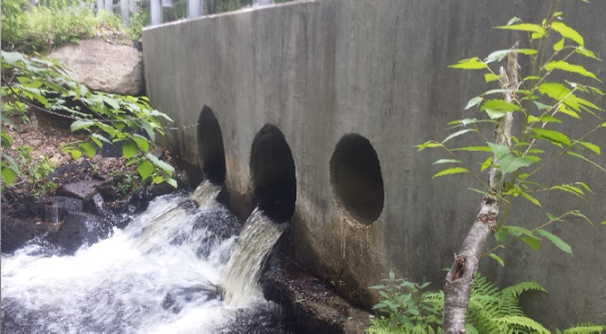
Hillsdale Road culvert outlet. Image by NBEP.
In 2022, the Wood-Pawcatuck Watershed Association (WPWA) received NBEP IIJA funds to develop a coldwater stream restoration plan for the Upper Wood River and Beaver River Subwatersheds in partnership with the Nature Conservancy (RI Chapter) and the RI Department of Environmental Management. This plan prioritized restoration projects based on opportunity, ecological impact, and cost. The top two projects– the Hudson Pond Dam removal and the Hillsdale Road Culvert – received planning and design funds from NBEP through IIJA. WPWA worked with consultants Fuss & O’Neil on both projects. “Projects like these are incredibly valuable toward restoring and protecting the cold water habitats which are vitally needed as refuges for wildlife during the increasingly hotter and dryer summer months. Both the Beaver River and the Kelley Brook are buffered by an incredible amount of protected land that ensures the investment of funding and effort we are making now will continue to pay ecological dividends in perpetuity!” says Christopher Fox, Executive Director of the Wood Pawcatuck Watershed Association.
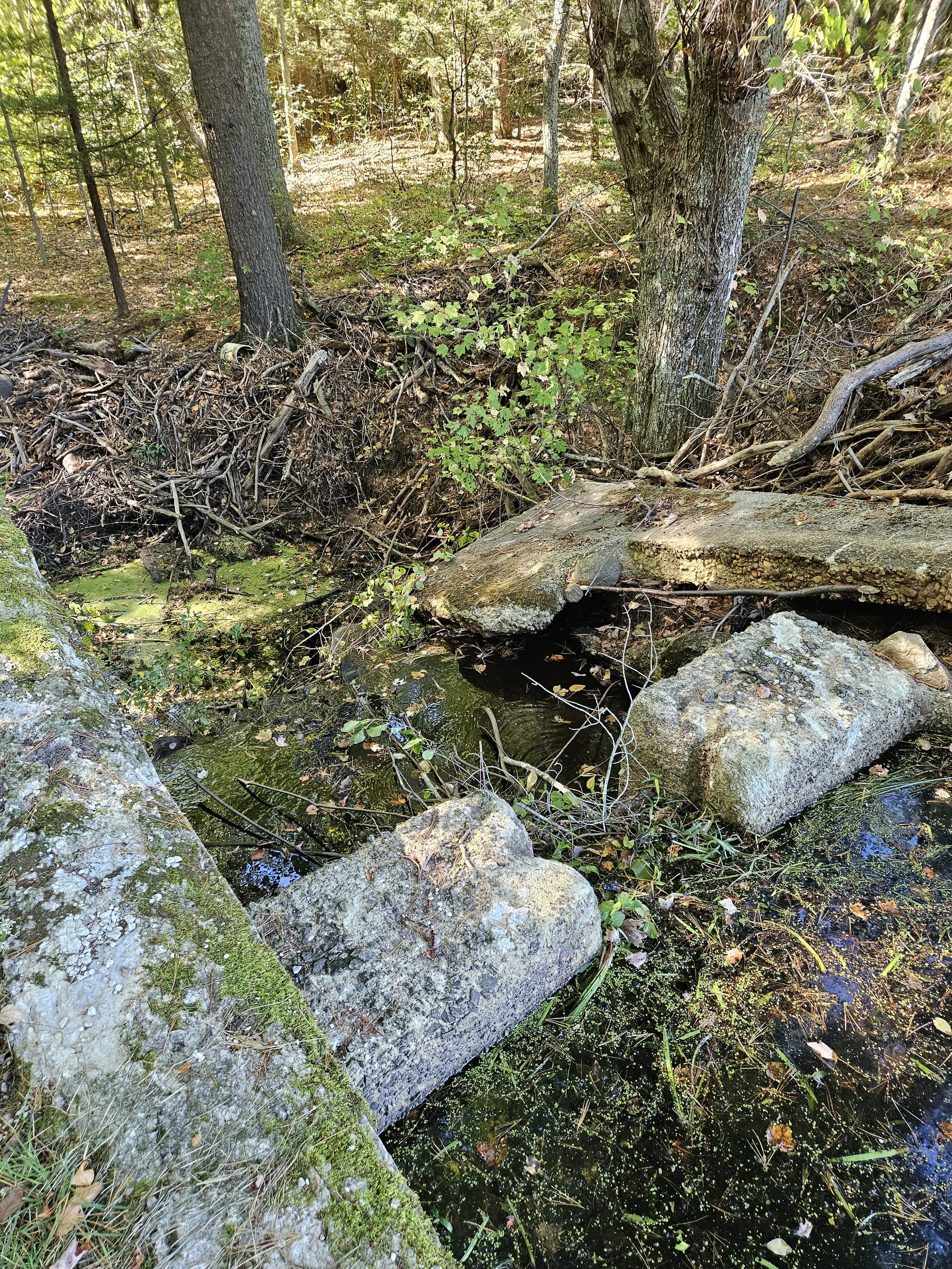
Hudson Pond Dam. Image by NBEP.
In April, 2025, the Wood Pawcatuck Watershed Association (WPWA) was awarded funding by NBEP to develop the 60% design for the Hudson Pond Dam Removal on the Kelley Brook in West Greenwich, RI, a cold-water tributary to the Upper Wood River. The goals of this project are to improve fish and wildlife habitat and passage, reduce water temperatures, and protect the public and downstream infrastructure from possible dam failure. The data collection, hydrologic and hydraulic analyses, and 60% design were completed in June, 2026, and a new award from NBEP was granted to the WPWA to complete final designs and permit applications in anticipation of summer 2027 construction.
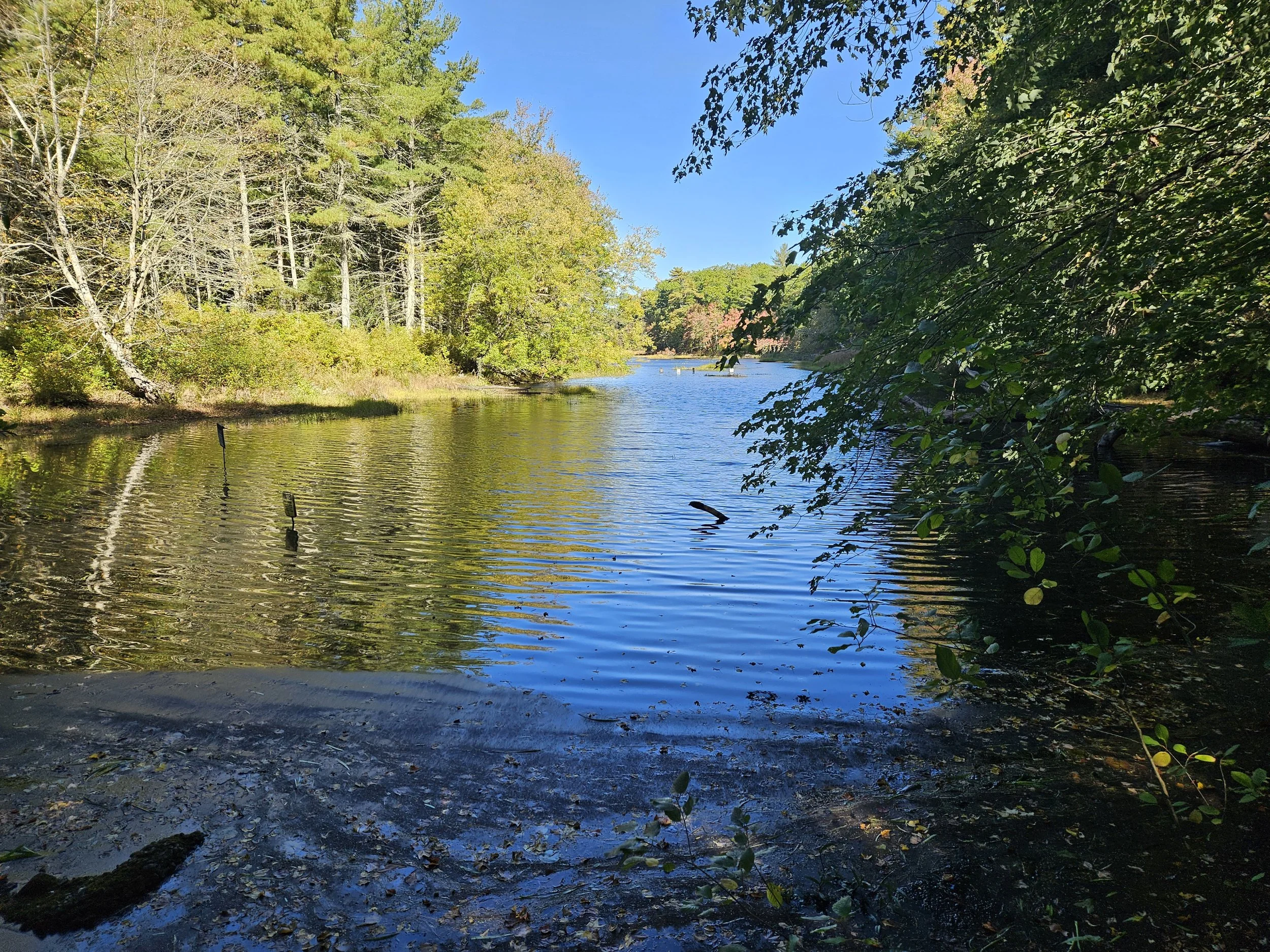
Upstream of the Hudson Pond Dam. Image by NBEP.
This dam removal will occur via a phased drawdown, which means rather than removing the entire dam at once, the spillway will be replaced with a stack of stop logs. Every few months for over a year, a log will be removed to allow slow release of the water from the impoundment. The goal of this approach is to give riparian vegetation and the natural stream bank time to reestablish naturally, which will reduce the costs of construction and sediment control, and to reduce a large downstream surge of water and sediment. “One of the most expensive and naturally disruptive activities of dam removal projects is the rapid transformation from pond to river. During rapid deconstruction, the cost to control, pass and divert stored water along with stabilizing sediment and vegetating newly exposed riverbanks can often be more expensive than the removal of the dam itself. Larger dams on mainstem rivers typically leave no choice but to make this rapid transition due to the sheer volume of water that must be managed. We are excited to try this softer-touch approach on a gently flowing first-order stream like Kelley Brook” says Fox.
Over on the Beaver River, a tributary to the Pawcatuck River, is the Hillsdale Road culvert, an undersized and perched culvert needing replacement with a cost-effective, open‐bottom structure designed to restore aquatic organism passage, increase hydraulic capacity, and reduce flood/erosion risk. Support from IIJA through NBEP and the National Park Service funded the full design and permits.
Hillsdale Road culvert. Image by NBEP.
The new culvert will achieve what the current culvert cannot – pass 100-year storm flows (adjusted for future flood inundation and frequency increases) and feature wildlife benches that provide terrestrial wetland wildlife passage through the box culvert and cross-channel in water weirs to maximize passage by native freshwater fish. The project is now shovel-ready and the only hindrance to constructing the project in 2027 is the need to raise additional project funding. The estimated construction cost range is $800,000 - $1,000,000. To date, WPWA has secured $399,000 in SNEP-SWIG funding toward the construction phase of this project. A $350,000 construction funding application to RI’s Climate Resiliency Fund is under review. The project expects to solicit bids from qualified contractors in early 2027. Once built, the project will restore aquatic organism passage to 1 river mile and improve flood resiliency over the 17-mile course of the Congressionally designated Wild & Scenic Beaver River.
Interested in learning more about aquatic habitat connectivity work in the region? Visit nbep.org/aquatic-connectivity.